Monday, July 11, 2016

IF YOU CHOOSE TO LOVE AN AWAKENED WOMAN

If You Choose an Awakened Woman~


Original Post on October 22, 2015 by Robin in Devine Energies

IF YOU CHOOSE TO LOVE AN AWAKENED WOMAN~~
If you choose to love an awakened woman, understand that you are entering into new, radical and challenging territory.
If you choose to love an awakened woman, you cannot stay asleep.
If you choose to love an awakened woman, every part of your Soul will be aroused, not just your sexual organs or even your heart.
Frankly, if you prefer a normal life, stick with a normal girl.
If you want a tame life, seek only a woman who has allowed herself to be tamed.
If you only want to dip your toe into the flowing waters of Shakti, stay with the safe, tamed woman who has not yet plunged into the wildness of the Sacred Feminine ocean.
It is comfortable to love a woman who has not yet activated her inner sacred powers, because she does not push your buttons.
She will not challenge you.
She will not press you into becoming your highest Self.
She will not awaken the forgotten and numbed-out parts of your Spirit that urge you to remember that there is more to your Life here than this.
She will not look into your weary eyes and send a lightning bolt of Truth through your body, jolting you awake and stirring long-lost desires for Soul Love within you.
A safe, unawakened woman will be wonderfully satisfying and soothing to your ego, heart, and body. She will walk quietly beside you and make you feel needed, responsible, like you are fulfilling your manly role.
If this is enough for you then accept it, love her with all your heart, remain faithful to her and thank her daily for the gift of her mild, unthreatening feminine presence in your life.
If this is not enough for you – if your heart, body and spirit is only craving the ‘other kind of woman’, the Wild One – then know that you are on the cusp of Soul-Shifting transformation.
Know that you are making a serious choice with karmic consequences.
If you choose to step into the aura and body of a woman whose spiritual fires are blazing, you are accepting that you need a certain level of danger and risk in order to grow.
Once you begin to love a woman of this nature, you must accept total responsibility for the life-changes that will then ensue.
Your life will not be sleepily comfortable all the time. Your life will not allow you to stay stuck in old ruts and stagnant routines. Your life will take on a radically-new flavour and scent. You will be ignited by the presence of the Wild Feminine, and it will begin to send electric shockwaves of spiritual Light through your entire chakra system, attuning you to the Call of the Divine.
Choosing to be sexually and romantically-intimate with an awakened woman takes masculine courage to walk fearlessly into the Unknown. But it will reap rewards beyond your mind’s comprehension.
She will take you into undiscovered worlds of mystery and magic.
She will lead you, mesmerised and half-drunk with love, into the wild forests of sensual ecstasy and wonder.
She will show you sacred skies so full and burning with stars that you will start to wonder if you are still living on the same planet that you were born on.
She will break and tear you open so that your fierce, passionate heart drives you half-mad with longing. You will want to consume and penetrate her on every level so that your Masculine Essence can consume and penetrate the world – illuminating the Universe with your devoted Love.
She will see you like you’ve never been seen before.
She will trust you.
She will appreciate you.
She will acknowledge your efforts to make her happy.
She will value everything good that you do, and everything good that you are.
She will not run from your darkness, because your darkness does not scare her.
She will embrace, kiss, caress and love you back to Life. She will speak words that your Soul understands. She will not punish you for your mistakes.
It is a monumental risk to love an awakened woman, because there is suddenly no place to hide. She sees everything, therefore she can love you with a depth and presence that your heart and body have yearned for so hard, so long, so fiercely…that you wonder whether you have actually been alive for all the time that she has been away.
Loving a woman like this is a choice you make to start living with your Soul on fire.
Your life will never be the same again once you’ve invited her energy in.
Take this risk on yourself, or step back, stay with the normal girl and accept a different, safer, more comfortable and somewhat calmer life.
Just make sure that if you choose the latter, you don’t spend the rest of your days with your eyes looking back over your shoulder, straining to see once again the hazy vision of Feminine Mystery that has now disappeared from view.
She has long gone..spiralling back up to the Stars, the distant Galaxies and the Heavens…from where She came.
~Sophie Bashford

Friday, June 17, 2016

Peaceful demonstration to mark election day on Saddle Lake Cree Nation

Tuesday, June 14th, 2016 1:05pm
Saddle Lake Cree Nation Councillor Shannon Houle: leading a demonstration for Idle No More. (File photo) 
Shannon Houle, a name synonymous in Alberta with the Idle No More movement, will not be running for a second term as councillor for the Saddle Lake Cree Nation – despite filing her nomination paper for the June 1 deadline. The election is scheduled for June 15.
By Shari Narine
Sweetgrass Contributing Editor
SADDLE LAKE CREE NATION
ORIGINAL NEWS COVERAGE: http://www.windspeaker.com/news/sweetgrass-news/peaceful-demonstration-to-mark-election-day-on-saddle-lake-cree-nation/

Shannon Houle, a name synonymous in Alberta with the Idle No More movement, will not be running for a second term as councillor for the Saddle Lake Cree Nation – despite filing her nomination paper for the June 1 deadline.
“I’ve been given no explanation why I can’t run,” said Houle. “I feel as if I’m being targeted.”
The election is scheduled for June 15.
All other seven councillors and Chief Leonard Jackson successfully filed their nomination papers.
Houle is one of 10 people, who had their nominations rejected by what she calls an “unofficial appeal committee.” Members volunteered to sit on the appeal committee and were not appointed by council. Houle says she had to find out through other channels that her nomination had been rejected. She also noted that she has been unable to reach electoral officer Ron Lameman to express her concerns or to get his ruling.
Houle can’t understand why her nomination has been rejected, because if the basis is the custom election process used by Saddle Lake Cree Nation then Houle’s nomination three years ago shouldn’t have stood either.
According to the custom election, those who serve on council must reside on the First Nation and not be involved in a common-law relationship.
Houle has two family residences on the Saddle Lake Cree Nation – although one has been condemned in the past year and a half – and she has had the same common-law partner for the past 17 years. They were joined in ceremony by an Elder.
In 2013, five complaints were filed against Houle’s nomination. She pleaded her case to the electoral officer and her nomination was allowed. She was elected.
According to Dr. James Makokis that set a precedent and there was no reason to believe that Houle could not run for a second term.
But more than that, he says, the custom election followed by the First Nation is antiquated and needs to change.
“They’re not our nehiyaw wiyasiwewina, which is our own Cree laws. They’re actually Indian Actpolicies that our people were forced to create under duress at that time. So some of those that exist are very discriminatory,” said Makokis.
He points to the fact that 50 per cent of First Nations members live off reserve, a necessity for a number of reasons, including lack of adequate housing on the reserve and the desire to pursue higher education. Members who live off reserve can vote.
Makokis has joined Houle, as well as three other people, whose nominations were rejected – Greg Cardinal, Louise Large, and Valerie Steinhauer – in organizing a peaceful protest on Wednesday.
“Our immediate goal is to be reinstated. That way we have a choice and opportunity and the people have a choice and opportunity to vote,” said Houle. “We want this issue finally addressed and dealt with and no longer waiting for the hope of another council…. We’ve been doing this for too long.”
However, changing the custom election will not be an easy feat. Agreement on changes has to come from members from both the Saddle Lake Cree Nation and the Whitefish Lake Nation, which each have their own land base. At one point, the two First Nations were together, but in the 1970s two Chiefs were elected and two councils created. But as they are recognized as one Nation under the Indian Act, they must have joint council meetings and issues such as elections, land-base and membership, must be jointly decided.
Houle says working on the custom election had been on her agenda during this past term, but Whitefish Lake First Nation’s attention was focused on court action to separate from Saddle Lake Cree Nation. It was unsuccessful.
Makokis sees changing the custom election as a vital step to the First Nation’s survival.
“As a concerned physician, who’s worked in our nations from 2013 to 2015, seeing the conditions that our people live in and are suffering through, I am worried about the health of our people, the prosperity of our people, the well-being of our people, if well-informed, qualified candidates, and our own relations, are continued to be excluded from participating in what is supposed to be a democratic process,” he said.
Restoring Harmony in Our Nation, as Houle and Makokis’s group is called, is about bringing back Cree ways and bring attention to procedural irregularities in the present custom election system.
The demonstration walk will begin at 8 a.m. starting from the Bison Auto Gas Station and ending at the Ayiwakes Hall, where voters are marking their ballots.

Sunday, March 27, 2016

Two Years Later and BILL C-33 FNCFNEA is not law

It has been two years later and out of all the bills the Conservative pushed through at a historically fast rate, some illegally like C-27 First Nations Financial Transparency Act and more, the First Nations Control of First Nation Education Act Bill C-33 is still the only bill that did not receive Royal Assent from the Crown's state of Canada.

However, even though it was put on "hold" in parliament it is still not removed.  "Be Aware and Beware"...as former Conservatives said, "we will work with willing partners..." - translation: we will do divide and conquer and get the First Nations to break treaty by entering into other agreement without ever honouring those Internationally Recognized Sovereign to Sovereign Treaties made with the Crown and the Indigenous Nations!

"BE AWARE & BEWARE!

Shannon Houle: Personal Reaction of the First Nations Education Annoucement 

http://www.cbc.ca/m/touch/aboriginal/story/1.2534081

Cookie-cutter solutions for First Nations education won't work

Posted:Feb 12, 2014 5:42 PM ET

Last Updated:Feb 12, 2014 10:36 PM ET

Twila Singer and two of her children attended Prime Minister Stephen Harper's announcement on First Nation education last week at the Kainai First Nation high school.

Twila Singer and two of her children attended Prime Minister Stephen Harper's announcement on First Nation education last week at the Kainai First Nation high school. Twila Singer

Twila Singer knows a thing or two about education on-reserve.

All five of her children are part of the Kainai First Nation and went to school on the Blood Tribe Reserve – in Blackfoot territory – close to Stand Off in southern Alberta. Her eldest son is now in college and her youngest is in Grade 1.

So when Singer caught wind of a community event last week, where Prime Minister Stephen Harper was to announce a historic education agreement between the federal government and First Nations, she put her ear to the ground.

“No one knew what was going on, we were left in the dark," said Singer.

Singer, who is part of the Blood Tribe's Idle No More group, had concerns regarding a potential announcement about the First Nations Education Act.

In a press release, Singer said, “We are concerned about how it will impact our treaty relationship and the promises made under treaty to respect our control over educating our children.”

The release also publicized a peaceful rally outside the Kainai Nation High School, where Prime Minister Stephen Harper made his announcement related to First Nations education

On the day of the event, Singer made the decision to go inside for the announcement.

"We just prayed and decided that it would be OK, it would be safe to go in," she said, but she didn’t expect what unfolded once they arrived inside.

Blue dots for uninvited guests

“We were separated at the door and given either a blue dot or a yellow dot. The blue dots were uninvited guests and were ushered to the gymnasium, and the invited guests were the yellow dots and they were brought to the auditorium where the dignitaries were.”

Along with about 40 others in the gym, Singer and her daughters, aged seven and 17, viewed what was happening in the auditorium on TV monitors. At the end, the invited guests were directed to go to the gym for a feast.

That’s when Singer was kicked out – for tweeting.

PM Stephen Harper and Chief Weasel Head

Prime Minister Stephen Harper and Chief Charles Weasel Head at last week's announcement about changes to First Nation education. (Arnell Tailfeathers)

“I was so confused. Everyone around me was on their phone. My baby has never experienced violence or anger, she started to cry, so I left. In all honesty I was really embarrassed.”

Then, her 17-year old daughter was asked to leave.

In a video posted online, Singer’s teen daughter, Bryn Taylor, is seen being confronted by three men, two standing in front of her, and one man at her side. The man on the side wraps his arm around her back for almost a minute, and then lifts her up by her arm.  

As people behind her shout “leave her alone” and “this is what my reconciliation looks like,” two men pick her up by each arm and she hits the floor, then they pick her up and escort her out.

“Our families were in there, our people were in there, people who we love and interact with every day, and I think she was wanting somebody to say something,” said Singer.

She said the air of silence mixed with confusion captured the essence of the announcement about changes to the First Nations Education Act that day.

“We didn't develop it, or have a referendum on it, we were left out of the loop,” she said.

Lacking consultation 

The Blood Tribe and Kainai Board of Education also put out a press release on the day of the announcement that said the proposed act “has not met the Crown’s legal duty to consult and accommodate.”

The release said the “proposed legislation is being forced on the Blood Tribe and it is similar to how the government assimilated Blood children through Indian residential schools.”

But consultation is something the engineers of the proposed First Nations control of First Nations education act tout. According to the official website, the agreement is the result of “intensive consultations, discussions, dialogue and studies.”

It stated that “the first phase included eight consultation sessions across Canada, more than 30 video and teleconference sessions, and online consultation activities, was completed in May 2013."

Arnell Tailfeathers, who was at the announcement as an invited guest in a media capacity tweeted to @CBC_Aboriginal, “Treaty 7 chiefs had a teleconference with Valcourt in Calgary. Valcourt hung up on them after he was done speaking.”

For Saddle Lake councillor Shannon Houle, the federal government’s assertion of consultation could not be further from the truth. 

Shannon Houle

Shannon Houle, of Saddle Lake Cree Nation in Alberta, attended the First Nations Education Act announcement at the Kainai High School last Friday. She was invited as a proxy. (Shannon Houle)

“In reality we haven't even been briefed on this, we haven't sat down with the prime minister as a nation,” she said.

“We do hold treaty and the AFN doesn’t not have the jurisdiction to do treaty for us, they just don’t. We have never given up that jurisdiction.” 

Houle drove eight hours from the Saddle Lake Cree Nation in central Alberta to attend Harper's announcement as an invited guest.

Protest outside FNEA announcement

A protest took place outside the high school where an announcement was being made about the First Nation Education Act. (Arnell Tailfeathers)

She was seated right behind Assembly of First Nations National Chief Shawn Atleo’sfamily.

Houle said during the ceremony to “seal the deal,” she stood up, put her right hand to her heart, raised her left fist in the air and said, “Chief Atleo, on behalf of my nation, as a descendant of Treaty 6 signatory signer of Chief Pakan, I am telling you right now I and my nation object and have opposed the First Nations Education Act and you have no right to speak on our behalf.”

She said Atleo responded by saying he agreed that not everyone has been consulted.

Shortly after, she said she was asked by local band members to leave the building.

'Chief Atleo, on behalf of my nation, as a descendant of Treaty 6 signatory signer of Chief Pakan, I am telling you right now, I and my nation object and have opposed the First Nations Education Act and you have no right to speak on our behalf.' - Shannon Houle, Saddle Lake Cree Nation

Houle says her First Nation has always rejected the First Nations Education Act, but proposed changes cause her more concern.

“If you look at other education administrators off-reserve and compare to the ones on- reserve, you will see that they already have to report two to three times more.”

According to the First Nations Control of First Nations Education website, “the legislation will improve transparency and promote accountability by establishing clear roles and responsibilities for First Nation education administrators, and annual reporting requirements.”

But Houle says those reporting mechanisms are already in place, and worries how often third party management will be called in.

Houle and others also have concerns that the new legislation will impose provincial off-reserve education standards that will supersede traditional and cultural teachings and education.

According to the FNCFNE website, “the legislation will require that First Nation schools teach a core curriculum that meets or exceeds provincial standards, that students meet minimum attendance requirements, that teachers are properly certified, and that First Nation schools award widely recognized diplomas or certificates.”

Houle says her people will be implementing their own education system, regardless of any federal legislation pushed though.

Self-determined First Nations education

“Our vision is for us to teach our language, our culture, but all taught  in our language," she said.  "We will incorporate the curriculum that’s required in society, for further education, however, we need to teach it in our way, the way our people have always learned for thousands of years.”

native-education-300-027884

Ottawa school children rally on behalf of First Nations education on Parliament Hill in June 2012. (Sean Kilpatrick / Canadian Press)

Houle says as a youth she went to an alternative school because the mainstream school system failed her. She now has two post-secondary degrees, one in arts and sciences, and the other in education.

“We have the highest post-secondary graduates in our community, and many of those have gone through alternative programs.”

Singer attributes the increase in graduation rates on the Blood reserve to a Blackfoot immersion program on the reserve. She said it’s kids who attended that kind of schooling who are succeeding in higher education. 

Singer said creating cookie-cutter solutions for First Nations is not going to work.

“Nobody else can decide what education is best for us but us, for every nation and I think it should be tailored to each nation and their belief.”

While she said she and her family are still shaken up and recovering from what happened at the FNEAannouncement event, she’s not afraid to speak out again.

“I just want to tell people to keep speaking up. If you know something is wrong speak up, because you are encouraging one more person to stand up, and eventually there will be enough people standing up that will  make things right,” she said.

Thursday, January 14, 2016

Shannon M Houle on Women as Leaders within Society

Shannon Houle Interview by Adeline Large


Published on Sep 6, 2015
  • Category

  • License

    • Standard YouTube License
  • Music

    • "Waniska" by Iskwew Singers ()
      • Artwork: "Our SIsters in Spirit" Mary Jane Houle
  • Hyperlink

  • Duration

      30:38
  • Location of Recording

    • Saddle Lake Cree Nation, Eagles Nest Healing Lodge

Wednesday, January 13, 2016

Alberta Native News: Alberta ASETS forum hosted by SIAFN sees collaboration among Treaty Nations

Alberta ASETS forum sees collaboration among Treaty Nations

Originally printed in December 2015 Edition Volume 32 Number 12
Alberta ASETS forum sees collaboration among Treaty Nations
by John Copley
(ANNews) – The first and so far only winter storm to hit the Capital Region this season did so on November 24, and though it caused a minor delay to the start of the two-day 2015 Alberta ASETS Forum, it didn’t put a damper on the spirits of the many people who attended the event, some driving through the snow from as far away as the Blood Reserve in southern Alberta.
The employment strategies symposium was organized, co-sponsored and hosted by the Six Independent Alberta (Treaty 6) First Nations Society (SIAFN); other sponsors included the Tribal Chiefs Employment and Training Services, NAIT, Interior Heavy Equipment, YTED ASETS, Service Canada and the Government of Alberta.
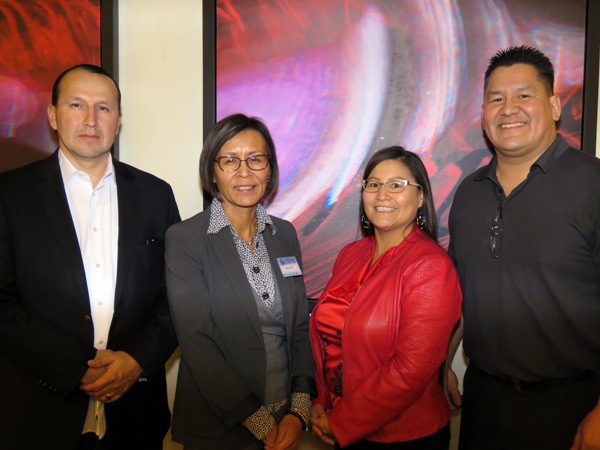
(l-r) Treaty 6 Grand Chief Chief Tony Alexis, Gina Potts COO of A3 Limited, SIAFN Executive Director Charlene Bruno and Derantech President MIke Deranger.
(l-r) Treaty 6 Grand Chief Chief Tony Alexis, Gina Potts COO of A3 Limited, SIAFN Executive Director Charlene Bruno and Derantech President Mike Deranger.
“This year’s Forum was very successful,” noted SIAFN Executive Director Charlene Bruno, who said the 2015 event, the first since 2012, “drew more than 120 professionals, business leaders and Chiefs from across Treaties 6, 7 and 8.”
Bruno said the November 24-25 Forum, held at the Double Tree by Hilton, “provides an ideal opportunity” for the province’s “three Treaty Groups to collaborate, share best practices, discuss upcoming opportunities and showcase First Nation businesses, entrepreneurs and employment strategies/partnerships. It is an excellent opportunity for our Nations to network and exchange ideas on what’s working in our programming. ASETS plays a vital role in our communities in that it works to increase self sufficiency.”
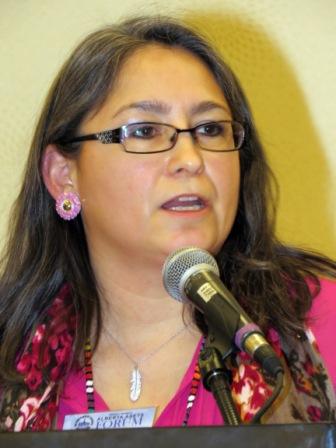
SIAFN Society President Shannon Houle.
SIAFN Society President Shannon Houle
“All Aboriginal Skills Employment and Training Strategy Stakeholders play an essential role in our communities to get our people trained and transitioned into employment,” noted SIAFN President Shannon Houle. “With more than 20 years of ASETS experience and challenges we are all well aware of the three pillars of success that ASETS is founded on – ensuring demand-driven skills development, forming partnerships with private sectors, provinces and territories and emphasizing greater accountability to achieve the best possible results. These pillars have their challenges, but as we serve the fastest growing population in Canada with the fullest potential and historically the hardest working population, I know and believe we can succeed because of the demand, diligence and dedication of hard-working people like you at the helm.”
Houle spoke about her first employment opportunity noting that “I was just a young, naive and impressionable Nehiyaw woman trying to find her place in society” when she got a summer job via a sponsorship through the ASETS partnership at the local human resources office, “now known as the Saddle Lake Training and Employment Centre.”
She spoke about the important role that employers, sponsors, mentors, Elders and others have when it comes to working with young people seeking their first encounter in the working world.
“My first job wasn’t a glamorous job; picking up garbage and helping to beautify our local lakes, beach and camping area. At 15 the only joy was being outside in the sun and being with my peers. When I got my first cheque I was so proud and excited – my own money that I worked for – like any teenager I spent that first cheque foolishly. It was empowering, it was liberating, and it gave me a sense of freedom. I know many of you are working with youth and older adults trying to find their way – but remembering those powerful feelings” of earning that first cheque “reminds me about the important role that you all play in being a part of an experience that helps to empower, guide and see (our young people) succeed.
“You all play such an important role in so many lives and for some, their first interaction with you is what helps them reach for their goals because a job is more than that; it’s a career – a place where many of us spend at least eight hours a day and sometimes more hours in a day than we spend with our families and friends. That’s why your roles are so crucial. The message I want to share with you is that as our people face old challenges and take on new ones in this ever-changing economic climate, they need you to help them find their place so they can fulfill their role in society. We have to always remember where we come from and where we want to go. Before contact we were a 100 percent working people; with your help and the help of people like you, we can get there once again.”
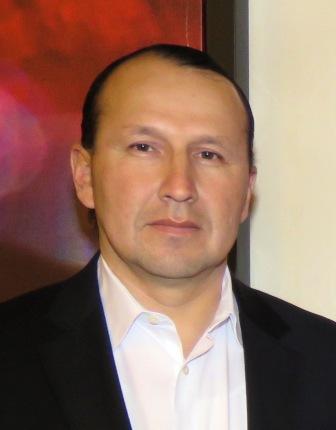
Treaty 6 Grand Chief Tony Alexis
Treaty 6 Grand Chief Tony Alexis talked about the important work being done in the communities to ensure that people are being trained and mentored and the significance of passing along ideas and strategies to the leaders and Chiefs of the communities so they in turn can fight for better conditions, better resources and better opportunities than what is now available.
“Filter your information and findings across to your leaders so they can be more effective in negotiations with government. Right now the way it works is that government is going to decide what the best strategy is going to be, how much money they have, how many resources they will offer and then say ‘that’s what’s available – work with it.’  That’s the way government has operated since the residential school days and the 60s Scoop.  They continue to say they have the best answer – ‘we’ve studied all your data and from that data we are going to contribute x-number of dollars to build your community’ – all without realizing how it works in the community. They look at the numbers, at the percentages of what it costs to get a person employed and then determine what that success factor is. When we look at it from the national level the Assembly of First Nations, our Chiefs should be bringing your information and input forward. Sometimes the government feels that Service Canada is not a treaty issue but the truth of the matter is that everything is, everything relates to who we are as a people. Everything relates to our ground, to our land, to our Elders.
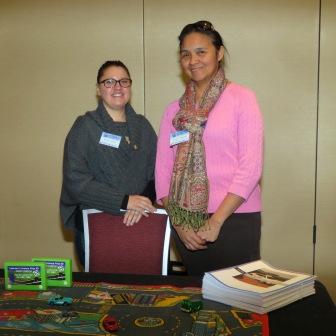
Melissa Jacknife and Coreen Youngchief work with driver education program.
“To the government it’s about statistics, economics, commerce; to us it’s about the core of who we are; it begins with the Creator and the spirit of the people and the gifts we have as a people. It’s important as technicians that you get your information to your leaders, to the Chiefs and Councils so they can bring these arguments to the regional and national level. Right now we are not hearing what it is you need to fight for, what it is you need to stand for. As technicians I encourage you to continue to do the good work that you do in supporting and helping the people in your community – keep reaching out to them. Right now in our nations we are at a point where we are succeeding more than ever. If you focus on the negative you may not see it but if you look at the good stories you’ll see that we have evolved to a place that when the next opportunity comes to us, it is going to be good for all of us. Those here today are succeeding as are many others in our communities; today we need to encourage our people, we need to help them replenish the energy and the spirit that we have here today. We have more academic educators than ever and on top of that we have people who are practicing their culture, their languages and their songs. It’s a new beginning, it’s a new day and we are in a good place so let’s work together, move together and give thanks to one another as we move forward.”
The two-day event heard from numerous speakers and presenters representing organizations and companies that included the Alberta Indian Investment Corporation, Blood Tribe, Trade Winds and NEAAI, Interior Heavy Equipment Operator School, Nautuasis Safety ServicesDerantech Welding, Junior Forest Rangers, Saddle Lake Employment and Training Maskwacis Employment Centre, Driftpile First Nation Training and Employment and more.
Saddle Lake HR Director Andrew Redcrow
“Earlier this spring we were trying to find a way to bring additional training initiatives to our Saddle Lake community,” explained Andy Redcrow, Saddle Lake Cree Nation Director of Human Resources. “We wanted to provide some heavy equipment training and that is a very costly endeavour. We learned that there could be funding available from a Canada-Alberta Job Grant program and after speaking with the Saddle Lake administration and our Public Works department we came up with a proposal and applied for the grant.”
Various departments and entities on the First Nation participated in the initiative and in mid-July the money was approved and training commenced two months later. The program was taken by 10 band members, all of whom passed. Eight are currently employed by Public Works and two others were hired elsewhere. The band provided two of the trainers; both had years of experience on heavy equipment. Interior Heavy Equipment School, with training sites in B.C and in Alberta provided the equipment and the extra trainers.
“We trained 10 people,” noted Redcrow, “on equipment that included graders, caterpillars, scrapers, front-end loaders and gravel trucks. Our driver training program also taught classes and graduated two Class 3 drivers” who are now operating gravel trucks. The Canada-Alberta Job Grant paid for two-thirds of the training costs with the Saddle Lake First Nation picking up the rest of the tab.
“We also wanted to train some of the people who work for administration,” added Redcrow, explaining that about 400 people are employed through Saddle Lake administration. “We looked at various options and in the end partnered with NAIT; some of our staff went on to take computer training as well as book-keeping and accounting.” Once the guidelines for funding were clear and fully understood, “it only took about a month to process the paperwork” and attain the grant.
Forum participants Sandee Willier and Colleen Courtoreille work with employment strategies on the Driftpile First Nation.
Various employment and training program leaders were also on hand to talk about their policies and procedures; each was similar in what they do and what they offer.
Colleen Courtoreille said the programs and services available through Driftpile First Nation’s employment service “are geared toward strengthening clients, increasing independence and building strong support networks” to help facilitate the process. “The employment services motivate, assist and support individuals and work with them as they choose their occupational direction. We help our clients develop a career path and then help them to attain the skills they’ll need to find employment and maintain long-term stability.”
“I’d like to thank and applaud everyone who attended this year’s Alberta ASETS Forum,” said SIAFN President Shannon Houle. “Thank you for making this Forum a success and for sharing your community’s best practices. The opportunity to work together and learn together enables us all to walk away feeling fulfilled and accomplished. I wish you all warmth and joy during the upcoming holiday season.”